Dr. Rahul Nath World-Renowned Peripheral Nerve Specialist
Director, Texas Nerve & Paralysis Institute
Two Brachial Plexus Injury & Peripheral Nerve Injury
Clinics & Surgery Centers
Houston, Texas, USA & Dubai, UAE
Patients from Asia, Africa, Australia , Europe and Middle East can get surgery done in Dubai UAE. Patients from North & South America can continue coming to our office in Houston TX.
Click on the map to enter the website
HOUSTON CENTER
DUBAI CENTER
Page is being loaded. Please wait.
<- Go directly to the webpage. ->
Texas Nerve and Paralysis Institute
Loading...
Close
Dr. Nath - Brachial Plexus injury expert specializing in erb's palsy and brachial plexus palsy treatment. Brachial Plexus Nerve Reconstructive Surgery -- Rahul Nath M.D. Texas Nerve and Paralysis Institute, Texas Children's Hospital, Texas Medical Center, Methodist Hospital, Brachial Plexus, Brachial Plexus Surgery, Erb's Palsy, Brachial Plexus Injury, Obstetrical Brachial Plexus Injury, Shoulder Dystocia, Brachial Plexus Surgeon, Brachial Plexus Doctor, United Brachial Plexus Network, Nerve Graft, Rahul Nath, brachial plexus surgeon.
Live chat is currently offline.
Live chat timings:
MONDAY to FRIDAY 8AM to 5PM CST
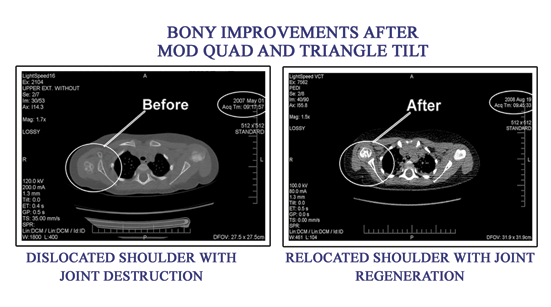
Scans are unaltered and taken at the level of the humeral head.
Colorful, uniques items that
show your support for
research in Brachial Plexus
injury.100 percent of
proceeds go to
charitable organisations.
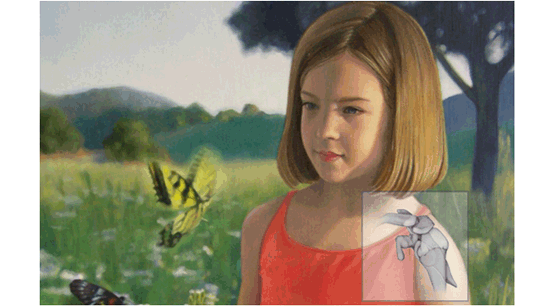
Nerve Surgery Illustrations & Animations
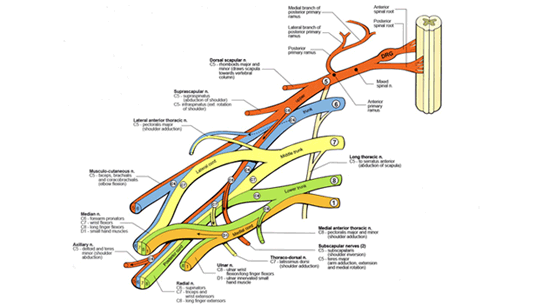
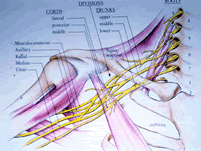
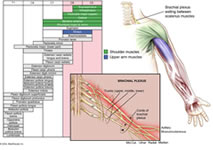
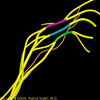
Brachial plexus anatomy is complex, but can be described in terms of basic function. The brachial plexus is derived from 5 "roots" or spinal nerves that exit the spinal cord in the neck. The nerves then pass through the axilla or armpit behind the collarbone (clavicle), and split into the final nerve branches that supply the muscles and skin of the shoulder, arm, elbow and hand.
The roots are named for the level of spinal cord that they exit. The upper roots (C5 and C6) exit from the cervical (meaning "neck") 5th and 6th vertebrae. The middle root (C7) exits above the 7th cervical vertebrae, and the lower roots exit from C8 (below the 7th cervical vertebra) and T1 (below the 1st thoracic vertebra). The upper roots supply upper structures (C5 to shoulder, C6 and C7 to elbow), and the lower roots supply the forearm and hand.
Injury to upper roots (the most common injury) is known as Erb’s palsy after the physician who described it. Erb’s palsy (paralysis) affects the shoulder and elbow, because the upper roots supply these structures. Injury to the lower roots is known as Klumpke’s paralysis, but is relatively uncommon, and very rarely exists by itself. Because the lower roots are injured, the hand is predominantly affected. If the lower roots are injured, the injury is generally so severe that all the roots of the plexus are involved, and the injury includes all parts of the arm. Upper root (Erb’s) injury is seen about 60% of the time, isolated Klumpke’s perhaps 5% of the time, and mixed injuries involving all elements of the plexus to some degree, make up 35% of patients.
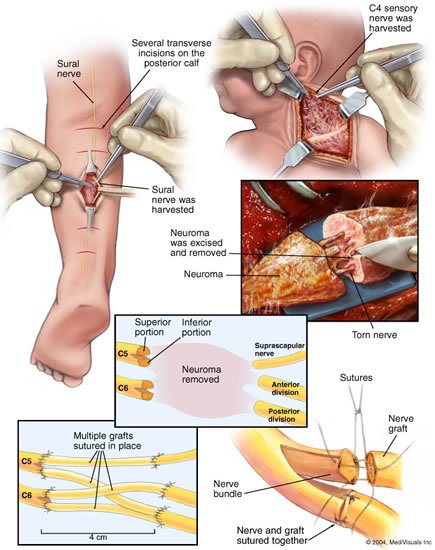
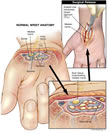
Nerve Scar Excision (Neurolysis), Nerve Grafting, Nerve Transfer and Neurotization.
Specific nerve surgeries that we use are: nerve scar excision (neurolysis), nerve grafting, nerve transfer and neurotization. It is sometimes necessary to perform tendon lengthening procedures in infancy in conjunction with the nerve procedures. These procedures are complex and must be used judiciously in order not to burn bridges for future reconstructive options.
Additionally, wrist, finger and thumb movements are often affected, leading to problems with hand grasp and finger pinch. A series of tendon/ muscle transfers can help to achieve excellent function with these injuries as well.
The basic principle is that some strong muscles and tendons can be re-routed to strengthen weaker functions by sewing the transferred tendons into the paralyzed ones.
Each child of course is very different in terms of type of injury, level of function, age at presentation, and many other elements which are addressed individually; it is often possible that patients require a combination of protocols for optimal recovery, in our experience.
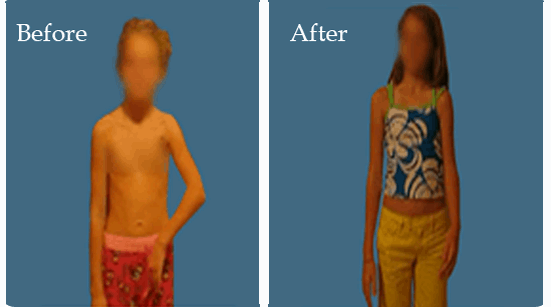
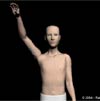
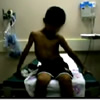
Patient example of nerve transfer surgery for brachial plexus of the patient's right arm. Notice how the right arm is paralyzed in the before image and functional six weeks later.
This website is intended as an informational resource only for families and patients suffering from
peripheral nerve injuries. No attempt to provide specific medical advice is intended. It is not intended to infer that surgery is always the best choice for a particular nerve injury.
You should always contact a specialist directly for diagnosis and treatment of your
specific problem, and a second opinion is always a good idea.